
"Over eight years of covering sports and gaming, our editorial team has learned one thing above all: responsible engagement starts with understanding digital mechanics. A user can't predict the outcome of a spin — but they absolutely should know the difference between a harmless simulator, educational content, and a platform carrying real financial risk. Given Bangladesh's local legislation, we approach this topic from a strictly informational standpoint." — Nadia Farzana Haque, Editor-in-Chief, iGaming Bangladesh
Roulette Online: How to Play Free, Demo and Live Roulette
Provider
Pragmatic Play
RTP
97.30%
Volatility
Medium
Min bet
$0.1
Max bet
$100
Max win
35x

18+ Disclaimer: This material is purely educational and does not replace professional advice. Gambling involves financial risk — play responsibly and only within the laws of your country. If you feel gambling is becoming a problem, seek support at BeGambleAware.org or through local helplines.
The iGaming industry demands clear-headed analysis and a solid grasp of probability. Users searching for information about roulette online often encounter a wall of marketing promises. This guide offers no direct sign-up links to offshore operators. Instead, it focuses on the mathematics, interfaces, and risks tied to 18+ entertainment.
Key takeaways:
- Online roulette is pure randomness: no strategy eliminates the built-in house edge (2.70% in European, 5.26% in American roulette).
- Success in free demo mode does not translate to profitability with real money — the emotional and financial stakes are fundamentally different.
- Bangladesh has no licensed online casino market. Participation on offshore platforms carries legal and payment risks.
- Unlike sports analytics, where team form and statistics can inform predictive models, roulette defies forecasting. Every spin is independent.

What Roulette Online Is and How the Game Works
Online roulette is the digital counterpart of the classic table game. The physical ball and wheel are replaced by a certified Random Number Generator (RNG) — or, in live formats, a real-time studio broadcast. The player's task remains the same: predict which numbered pocket the ball will land in. The core difference between digital and traditional roulette casino play comes down to speed and the algorithmic, rather than mechanical, nature of the randomness.
Every roulette game online rests on one principle: independence of outcomes. The software calls a cryptographic algorithm — SHA-256, for instance — to select an integer within a defined range in milliseconds, then renders the result on screen.
"Each algorithm launch is independent: neither the player nor the casino can predict or manipulate the results of a spin." — RNG and Fair Play in Mobile Roulette, Yogonet, 2024. https://www.yogonet.com
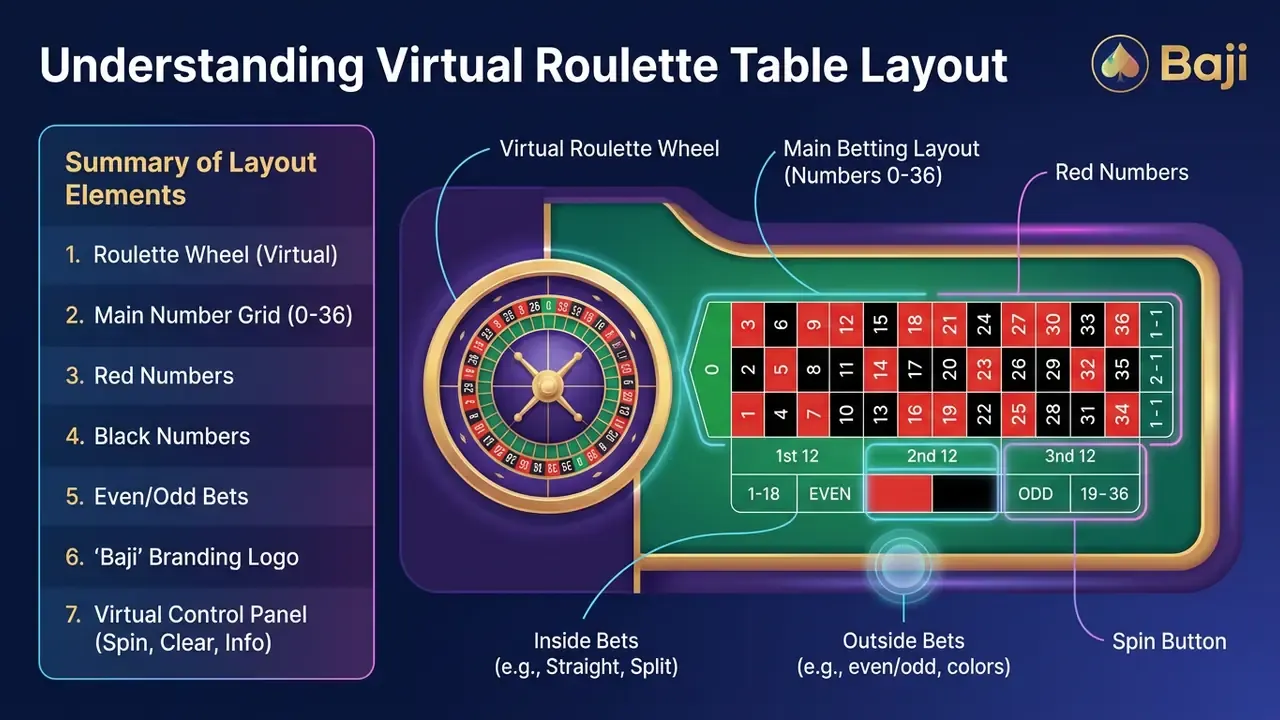

Roulette Wheel, Table and Spins
The digital table has two main information hubs: the roulette wheel (where outcomes are generated) and the roulette table (where bets are placed). The European wheel features 37 sectors — numbers 1 through 36 alternating red and black, plus a single green zero. The table layout mirrors this structure precisely: a central grid of individual numbers, surrounded by blocks for broader group wagers.
A physical roulette wheel is a solid wooden disc with a slightly convex profile. The metal dividers between pockets are called frets (or separators), and the pockets themselves — well, in traditional croupier jargon they're sometimes called canoes. In the digital version, these elements are reproduced visually. The ball animation?
It's just a graphical accompaniment to a result that's already been determined mathematically.
The spins process begins when the user clicks the launch button. At that instant, the RNG generates a number. The spinning ball you see on screen is decoration — the outcome was decided before the animation started. This approach enables playing roulette at a much faster pace: while a live studio round takes 30–60 seconds, an RNG spin resolves almost instantly.

How Betting and Payouts Work in Roulette
Before placing any wager — even a virtual one — it helps to understand the basic logic connecting bets, odds, and payouts. The flow is straightforward: you place chips on the roulette table before the "no more bets" announcement. Each bet corresponds to a specific group of numbers, and each group has a fixed payout ratio.
Here's the key relationship: the fewer numbers your bet covers, the higher the payout — but the lower your probability of winning. A straight-up bet on a single number pays 35:1, while a red/black wager pays just 1:1. The catch is that the mathematical expectation remains equally negative across all positions on the table. Whether you bet on one number or eighteen, the house edge stays the same.
If you place multiple bets on a single spin, each winning position pays out independently. Your total return is the sum of all successful wagers.
This is worth noting because many beginners assume combined bets somehow "cancel out" the house advantage. They don't.
The payout structure creates an illusion of choice. In reality, every roulette game offers the same expected return — roughly 97.30% in European and 94.74% in American versions. The variety of betting options affects volatility (how wildly your balance swings), not the long-term outcome.
How to Play Roulette Online for Free or in Demo Mode
Starting with free roulette requires zero financial commitment. Simply launch a demo mode on an educational or independent portal. The primary function of a roulette demo is to demonstrate how the interface and RNG algorithms work using virtual chips. This creates a safe environment where you can play free roulette, learn the rules, and avoid both local gambling restrictions and monetary risk.
One important nuance: regulatory standards (GLI-19, Gaming Laboratories International, 2024) separate product testing by mode and configuration. You cannot assume RNG equivalence between demo and real-money versions without a specific certificate or code review from the provider. That said, certified demo versions do use the same mathematical probability models.
[📝 CHECKLIST: Risk-free start, step by step.
1
Open a browser-based roulette simulator — no registration needed.
2
Study the layout of inside and outside betting zones on the table.
3
Place a few test bets across both areas.
4
Run 20–30 spins to observe how quickly virtual funds deplete.
5
Record your results and close the session.
Semantics: Checklist formatted as an HTML list <ul>.]
When to Choose Roulette Demo and Roulette Simulator
Launching a roulette demo makes sense when you want to test table limits, practice click speed, or understand how combination bets work. A roulette simulator gives you an interface that mathematically mirrors the real system but operates in complete isolation from deposit accounts. No money in, no money out. Just mechanics.
Editorial case study: While preparing educational materials, we analysed beginner behaviour using the popular Martingale tactic. Testing on a simulator platform revealed something telling: with a hypothetical starting balance, a streak of eight consecutive same-colour outcomes — an event with roughly 1/256 probability — inevitably occurs given enough spins. Over a longer horizon (500+ spins), progression strategies in playing roulette lead to exponential growth in virtual losses. The simulator brilliantly demonstrates the futility of such methods against raw mathematics.
Beyond Martingale, users frequently test other systems:
- D'Alembert —adjusts the stake by one unit after each loss or win. Less aggressive than Martingale, but equally powerless against RTP.
- Fibonacci —stakes follow the Fibonacci sequence (1, 1, 2, 3, 5, 8…). The progression is gentler, yet during long losing streaks the bet size still escalates sharply.
- Paroli —the stake doubles after each win (reverse Martingale). Designed to capitalise on short winning runs, but it doesn't shift the underlying mathematical expectation.
- Labouchere —the player creates a number sequence and bets the sum of the first and last numbers; wins remove them, losses add a new number.
- James Bond —a fixed combination of bets covering most of the table (e.g., 70% on 19–36, 25% on 13–18, 5% on zero).
None of these strategies alter the base RTP of 97.30% (European roulette) or 94.74% (American). They only manage dispersion within a session — how bumpy the ride feels, not where it ends.
"Beginners are advised to use demo for no more than 2–3 sessions to learn the rules, then move to minimum stakes of €0.10–€0.20 with strict loss limits." — The Truth About Demo Mode Games, 2025. https://www.truthaboutdemomode.com
What Free Roulette Can and Cannot Show Before Real Money Play
Any free roulette experience perfectly models probabilities and the mathematical tempo of the game. What it completely distorts is the psychological load. The mode is useful for studying the interface — before a person even theoretically considers real money platforms.
Mechanics and long-run return are identical. However, behavioural research shows that features like auto-play without real financial constraints measurably increase gambling intensity:
"The introduction of auto-play increased total wagering by 6.9–9.1% and the number of spins by approximately 3%, without changing net losses." — Frontiers in Psychiatry, 2024 (Bayesian time-series analysis). https://www.frontiersin.org/journals/psychiatry
In roulette for free mode, people easily make aggressive moves — big bets, rapid-fire spins, chasing streaks. The moment real money enters the picture, the emotional weight multiplies the risk of irrational decisions. That gap between demo confidence and real-money anxiety is something no simulator can replicate.
European and American Roulette: The Key Differences
The central distinction between European and American roulette lies in the number of zero sectors on the wheel. This single structural detail directly shapes the house edge. The European version has 37 pockets (one zero), while American roulette features 38 (an additional double-zero sector). One extra pocket. Nearly double the operator's advantage.
| Feature | European Roulette | American Roulette | French Roulette |
|---|---|---|---|
| Wheel sectors | 37 (numbers 0–36) | 38 (numbers 0–36 plus 00) | 37 (numbers 0–36) |
| Zero sectors | Single zero | Two (0 and 00) | Single zero |
| House edge (base bets) | 2.70% | 5.26% | 2.70% (1.35% with La Partage) |
| Return to player (RTP) | 97.30% | 94.74% | 97.30% (98.65% with La Partage) |
| Payout on straight-up | 35:1 | 35:1 | 35:1 |
| La Partage / En Prison | Not applied | Not applied | Applied |
"European roulette gives the casino an edge of $2.70 per $100 wagered; American roulette — $5.26, nearly double." — Evidence-Informed Overview of Online Roulette, 2025. https://www.evidenceinformedoverview.com
The difference is stark. With identical payout ratios (35 to 1 for a single number), the chances of landing in the right pocket on an American wheel are simply lower. American roulette has historically been considered less favourable for anyone who analyses expected value. Worth noting separately: the five-number bet (0, 00, 1, 2, 3), which exists only in American roulette, delivers the worst payout ratio on the entire table — 6:1 covering just 5 of 38 sectors.
And then there's French roulette. The wheel is identical to European — 37 sectors, single zero. But the French version includes two additional player-friendly rules:
- La Partage — if zero hits, the player automatically receives half of their even-money bet back (red/black, odd/even, 1–18/19–36). This cuts the house edge to 1.35% for those positions.
- En Prison — when zero lands, the bet is "frozen" for one more spin. If the next result matches the chosen position, the full stake returns; if not, it's lost.
French roulette is mathematically the most favourable variant for the player. In demo catalogues, though, it appears less frequently than its European or American counterparts.
Why Single Zero Matters
The single zero sector carries decisive mathematical weight — it's the mechanism that generates operator revenue. If you bet on black and green zero appears, your stake is gone.
In the European variant, the probability of losing on an even-money bet is 19/37. Step over to the American table (adding 00) and that probability rises to 20/38. The addition of double zero effectively doubles the casino's advantage: from $2.70 to $5.26 per $100 wagered.
— Evidence-Informed Overview of Online Roulette, 2025. https://www.evidenceinformedoverview.com
This is why expert consensus points toward European — or, better yet, French — format for reducing bankroll volatility. It won't eliminate the house edge, but it narrows the gap meaningfully.
Live Roulette vs Standard Online Roulette
Live roulette streams the game from a studio with a physical wheel and a real croupier. Standard online roulette runs entirely on RNG software — no human dealer involved. For the user, it's a choice between a television-style format with chat interaction and a solo session in arcade mode.
"RNG algorithms generate sequences without discernible patterns: neither the player nor the casino can predict or alter the result." — RNG and Fair Play in Mobile Roulette, Yogonet, 2024. https://www.yogonet.com
Mobile adaptation means both formats are accessible directly in a smartphone browser. No app required.

What Changes When a Dealer Runs the Game
Having a dealer at the table completely reshapes the social dynamics and rhythm of playing roulette. A human with a ball dictates the time for considering bets, closes the wagering window, and announces results aloud.
In standard roulette games online, a spin generates instantly on click. In a live studio, one round can take 30 to 60 seconds. The slower pace gives you time to think — but it also activates a social trust factor. Watching a real wheel spin in real time creates a sense of security reminiscent of a traditional offline casino. That feeling is powerful. It's also, strictly speaking, irrelevant to the mathematics.
Modern live studios use optical scanners (OCR — Optical Character Recognition) to instantly read the winning number from the physical wheel. The system automatically detects the ball's position and transmits the result to the player's screen, ensuring instant events detection, processing, and translation to the user.
Mobile Play and Access from Different Devices
HTML5 technology has effectively erased the boundary between desktop and mobile access to roulette online. Interfaces scale to phone screens, allowing touch-based betting and live stream viewing without quality loss.
"For live roulette to function properly, a connection of at least 5 Mbps download and 1 Mbps upload is required." — Technical specifications, Evolution, 2025. https://www.evolution.com
This matters particularly for Bangladeshi networks. If your connection drops mid-round, the server calculates the result autonomously — you'll see the outcome only after reconnecting. No do-overs.
Mobile UX elements deserve separate mention. Features like auto-play and one-tap bet repeats can measurably intensify gambling behaviour:
"Auto-play increased total wagering by 6.9–9.1% without changing net losses — the interface changes intensity, not mathematics." — Frontiers in Psychiatry, 2024. https://www.frontiersin.org/journals/psychiatry
A convenient interface is not a neutral interface. Keep that in mind.
Rules, Bets and Odds Every Player Should Know
Before interacting with any simulator, you need to grasp the fundamentals: rules, bet types, and the odds built into each position. The rules require placing your wager before the "no more bets" call. Whether you plan to play roulette online casually or study the mechanics in depth, every bet is calculated individually based on a fixed payout table and the chip's position on the roulette table.
🔍 E-E-A-T Fact Check: Can you predict RNG spins? A common myth claims that ten consecutive red outcomes increase the chances of black on the next round (Gambler's Fallacy). Certified laboratories — iTech Labs, for example — test RNG for randomness, independence, and unpredictability, which directly rules out predicting future results from past ones. eCOGRA describes RNG auditing as a verification of fair gaming standards. The software has no mechanism for "paying back" or remembering. The chance of winning or losing on spin 11 is absolutely identical to the chance on spin 1.
Main Bet Types on the Roulette Table
The table architecture divides chips into two broad categories: Inside (internal) and Outside (external).
Inside positions include Straight Up (a single number), Splits (two adjacent numbers), Streets (a row of three), and Corners (a cross of four). Chip placement is precise: Straight Up goes in the centre of the number; Split on the line between two neighbours; Street on the outer edge of a three-number row; Corner on the intersection of four numbers; Line (Six Line) on the junction of two adjacent streets, covering six numbers.
Outside bets cover broader sectors: Dozens, Columns, Red/Black, Odd/Even, and 1–18 / 19–36. For beginners, outside bets deliver more frequent wins, which keeps the experience engaging. But — and this is crucial — the mathematical expectation at every position on the table is equally negative.
Complete Payout Table for Roulette Bets
Below is the full payout table for major bet types in European roulette (37 sectors). In the American version (38 sectors), payout ratios are identical, but probabilities are lower — and house edge correspondingly higher.
| Bet Type | Numbers Covered | Payout | Win Probability (European) | Win Probability (American) |
|---|---|---|---|---|
| Straight Up (en plein) | 1 | 35 : 1 | 2.70% (1/37) | 2.63% (1/38) |
| Split (à cheval) | 2 | 17 : 1 | 5.41% (2/37) | 5.26% (2/38) |
| Street (transversale pleine) | 3 | 11 : 1 | 8.11% (3/37) | 7.89% (3/38) |
| Corner (en carré) | 4 | 8 : 1 | 10.81% (4/37) | 10.53% (4/38) |
| Line (sixaine) | 6 | 5 : 1 | 16.22% (6/37) | 15.79% (6/38) |
| Dozen / Column | 12 | 2 : 1 | 32.43% (12/37) | 31.58% (12/38) |
| Red / Black, Odd / Even, 1–18 / 19–36 | 18 | 1 : 1 | 48.65% (18/37) | 47.37% (18/38) |
The mathematical relationship is simple: the true probability of winning is always slightly higher than what the payout coefficient implies. For example, a fair payout for Straight Up in European roulette would be 36:1 (the inverse of 1/37 minus the original stake), but the casino pays 35:1. That one-unit gap is the house edge.
How Odds and House Odds Affect Expectations
Understanding the terms odds and house odds is foundational to responsible gambling — it's what protects you from fantasies about a guaranteed win.
An RTP (Return to Player) of 97.30% means that out of every 1,000 units wagered in total, the system statistically retains 27 units as the operator's commission. For every €100 in bets, the casino keeps an average of €2.70 in European roulette and €5.26 in American.
"Each spin is independent: the RNG has no memory of past results, and the probability of an outcome does not change based on betting history." — RNG and Fair Play in Mobile Roulette, Yogonet, 2024. https://www.yogonet.com
House edge doesn't prevent short-term lucky streaks — or prolonged losing runs. Knowing this concept dismantles the hope that any betting system can generate profit as a reliable income source. Roulette is entertainment with a built-in cost, not an investment vehicle.
Can You Win Real Money and What to Expect from Roulette Casino Play
Disclaimer: This information is general in nature and does not replace professional advice. Gambling involves financial risk — play responsibly and only within the laws of your country.
Using free roulette online simulators and actually depositing real money are two fundamentally different experiences from a stress perspective. The transition to real money radically shifts the emotional landscape: abstract numbers on a screen become tangible risk.
"Demo mode is not emotionally equivalent to real-money play: success in free games does not mean profitability in a casino." — The Truth About Demo Mode Games, 2025. https://www.truthaboutdemomode.com
A user can win a local session in a roulette casino. But they should be prepared for strict KYC (Know Your Customer) verification, potential payout delays, and the pressure of bonus wagering requirements.
⚠️ Alert: The Emotional Gap and Its Risks Successful strategy tests in free demo mode create a dangerous "illusion of control" (BeGambleAware guidelines). The emotional weight of losing real money can trigger the urge to chase losses and escalate bet sizes. You should never approach roulette deposits as a source of income.
In our review of local market processes at iGaming Bangladesh, we've covered the legal landscape in detail: direct participation in online casinos from Bangladesh involves legal and infrastructural complications. The absence of a licensed market means consumer protection largely falls on the user's own shoulders.
Specific Risks for Players in Bangladesh
Since Bangladesh has no licensed online casinos, users turning to offshore platforms face several concrete risks:
- Payment restrictions:Local mobile financial services (bKash, Nagad) and bank cards may block transactions linked to gambling operations. Recovering funds from a non-paying operator is virtually impossible — there's no local regulator to appeal to.
- Legal uncertainty:Using a VPN to bypass geographic blocks does not create legal protection. In a dispute with an operator, the user has no jurisdictional tools for recourse.
- Fraud detection:Without a UKGC, MGA, or equivalent regulatory licence, there's no way to verify RNG fairness, actual RTP figures, or payout timelines. Red flags for scam casinos include: no publicly listed licence, unrealistic bonuses with hidden wagering conditions, and absence of KYC procedures.
Always read the platform's Terms and Conditions and set strict session limits. The industry sells emotions through negative mathematical expectation — it is not an investment mechanism.
Sports Analytics vs Roulette: Why the Approach Differs
For readers familiar with our sports content, this distinction matters. Analysing roulette is fundamentally different from analysing sporting events. In sports betting, data on team form, squad composition, and historical statistics can inform models with positive expected value — given sufficient expertise. Roulette is pure randomness where each spin is independent and the house edge is constant. No volume of data on past spins provides predictive power. This is precisely why our editorial team approaches roulette strictly from an educational, not a forecasting, perspective.
FAQ About Roulette Online Access and Gameplay
Do You Need to Download Anything to Play Roulette Online?
No. You don't need to download installation files anymore. With the industry's shift to HTML5 standards and secure TLS 1.3 cryptographic tunnels, sessions to play online roulette load safely right in a modern browser tab — Chrome, Safari, or others.
"Many free roulette platforms work without download or registration — the game launches directly in the browser via HTML5." — Free Online Roulette – No Download, No Registration, Roulette77, 2024. https://www.roulette77.com
The instant-play architecture protects you from malicious .exe files while providing quick access to free roulette. All calculation logic runs remotely on the operator's secured servers. Your local device serves only as a display — results don't depend on your PC or phone's processing power.
Is Online Roulette Legal in Bangladesh?
Bangladesh has no licensed online casino market. The Public Gambling Act 1867 (with subsequent amendments) prohibits gambling, though its precise application to online platforms remains in a grey zone. Using offshore sites via VPN does not provide legal protection: if a dispute arises with an operator, the player has no jurisdiction for appeal. This material is strictly informational and is not an encouragement to participate in online gambling.
Can You Play Roulette for BDT (Bangladeshi Taka)?
Most international offshore platforms operate in USD, EUR, or cryptocurrencies. Direct BDT support is rare. Additionally, local payment systems (bKash, Nagad, bank transfers) frequently block gambling-related transactions. This creates an additional barrier and a real risk of frozen funds.
Do Roulette Strategies Actually Work?
No strategy — Martingale, D'Alembert, Fibonacci, Paroli, Labouchere, or James Bond — can alter the casino's mathematical advantage. These systems manage only dispersion within a session: they affect how quickly and with what amplitude your balance fluctuates, but not the final outcome over a long horizon. RTP remains 97.30% (European) or 94.74% (American) regardless of the betting scheme.
Are the Results of Online Roulette Spins Truly Random?
Yes. In RNG versions, each round's result is determined by a random number generator certified by independent laboratories (iTech Labs, eCOGRA, GLI). The algorithm has no "memory" of previous spins. In live roulette, the result comes from the physical interaction of wheel and ball — equally random. Optical scanners only read the outcome; they don't create it.
Last updated: June 2026